Ask in business concepts
A semantic model maps Farm, MilkLot and QualityMeasurement to real tables, columns and keys. A virtual graph answers a question from the source database itself, so the data does not have to move.
Early accessRustHTTPMCP
Describe your business once. GraphOWL maps it to your databases, answers questions in your own concepts, explains every answer, and keeps AI agents inside the rules. History, validation and review are part of the engine, not added on top of it.
Two ways in: a call where the author walks you through it, or 30 minutes of your own hands-on access to a live demo on a synthetic dairy cooperative.
Enter your name and email and you are in at once, with 30 minutes of hands-on access to the demo. Or book a 30-minute walkthrough call with the author (Tuesdays and Saturdays, India time). Up to five people use the demo at a time.
Prefer to watch first? See the recorded walkthrough.
You are signed in as soon as you get your passcode. Open Query in the left menu, paste a question and run it. When your 30 minutes end you are signed out and anything you did is erased.
SELECT ?class (COUNT(?s) AS ?n)
WHERE { GRAPH ?g { ?s a ?class } }
GROUP BY ?class ORDER BY DESC(?n)Your passcode is also an API key during your slot: send it as a bearer token.
export PASSCODE=OWL-XXXX-XXXX
curl -X POST https://demo.graphowl.app/sparql \
  -H "Authorization: Bearer $PASSCODE" \
  -H "Content-Type: application/json" \
  -d '{"query": "SELECT ?class (COUNT(?s) AS ?n)
        WHERE { GRAPH ?g { ?s a ?class } }
        GROUP BY ?class ORDER BY DESC(?n)"}'
from graphowl import GraphOWL
owl = GraphOWL(url="https://demo.graphowl.app",
api_key="OWL-XXXX-XXXX", workspace="dairy-coop")
rows = owl.query.sparql("""
SELECT ?class (COUNT(?s) AS ?n)
WHERE { GRAPH ?g { ?s a ?class } }
GROUP BY ?class ORDER BY DESC(?n)""")const res = await fetch("https://demo.graphowl.app/sparql", {
method: "POST",
headers: { Authorization: "Bearer OWL-XXXX-XXXX",
"Content-Type": "application/json" },
body: JSON.stringify({ query: `SELECT ?class (COUNT(?s) AS ?n)
WHERE { GRAPH ?g { ?s a ?class } }
GROUP BY ?class ORDER BY DESC(?n)` }),
});
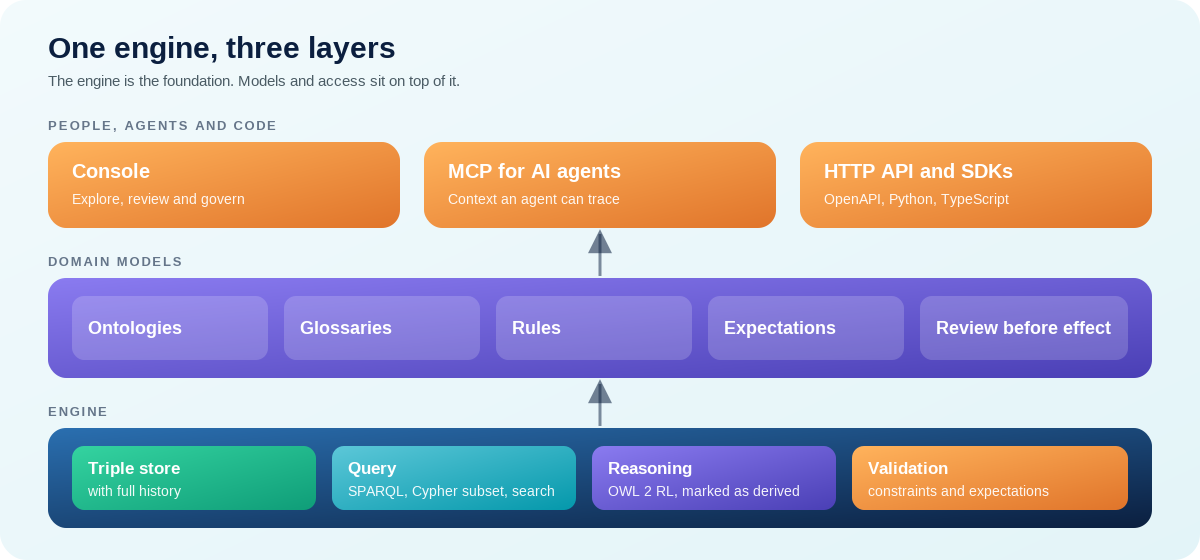
const { rows } = await res.json();A semantic model is only useful if it does work. GraphOWL uses the same approved model to reach data, justify answers, govern change and constrain agents.
A semantic model maps Farm, MilkLot and QualityMeasurement to real tables, columns and keys. A virtual graph answers a question from the source database itself, so the data does not have to move.
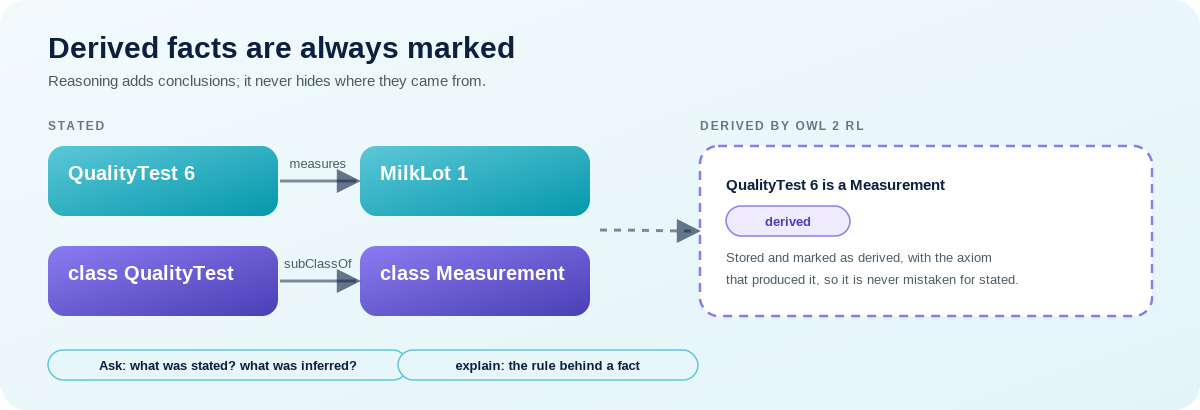
Every fact keeps its source and its history. Reasoning is stored apart and marked as derived, with the rule that produced it, so a conclusion can be checked or challenged.
Proposals, a review queue and decisions with reasons. Model diffs and competency questions show what a change touches before it takes effect.
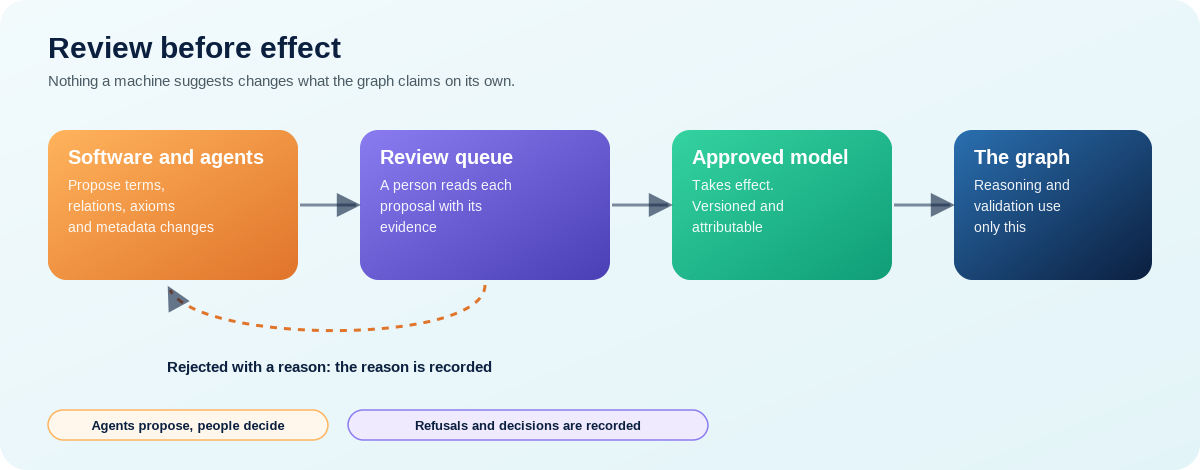
An MCP server with 102 tools, workspace-scoped sessions and grants. Refusals are recorded. Agents propose; people decide.
One engine, many domains. A data catalog, a compliance model or a product domain is one pack on the same engine.
Ask a source database in place through an approved mapping, in business concepts, without bulk-copying it into a graph store.
Take terms from candidate to class, property and source mapping, with validation and a query at the end of the path.
Say which records break which rule, and why, with the evidence one click away.
Agents work through the model: scoped to a workspace, limited by a grant, proposing changes that a person approves.
Reconcile inconsistent terms across databases and applications while keeping what each source means.
Definitions, owners and lineage queried like any other fact, in the same graph as the domain model.
The pieces the four jobs rest on.
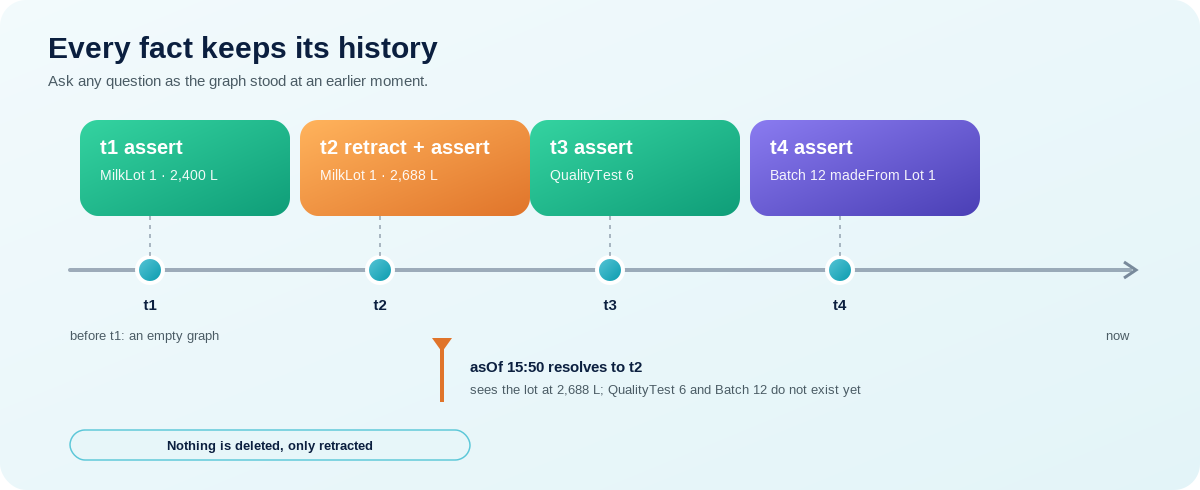
Nothing is deleted, only retracted. Ask any question as it stood at an earlier moment.
OWL 2 RL derives what follows from the model, and marks it as derived so it is never mistaken for stated.
Models proposed by software are proposals until a person approves them. Nothing changes the graph unreviewed.
Two ways to ask the same graph. SPARQL 1.1 and a documented openCypher subset, with honest errors.
SHACL-style constraints and quality expectations report what does not fit, without changing it.
Ontology, glossary, rules and expectations bundled per domain, so one engine serves many.
Query a source database in place, through a mapping a reviewer approved.
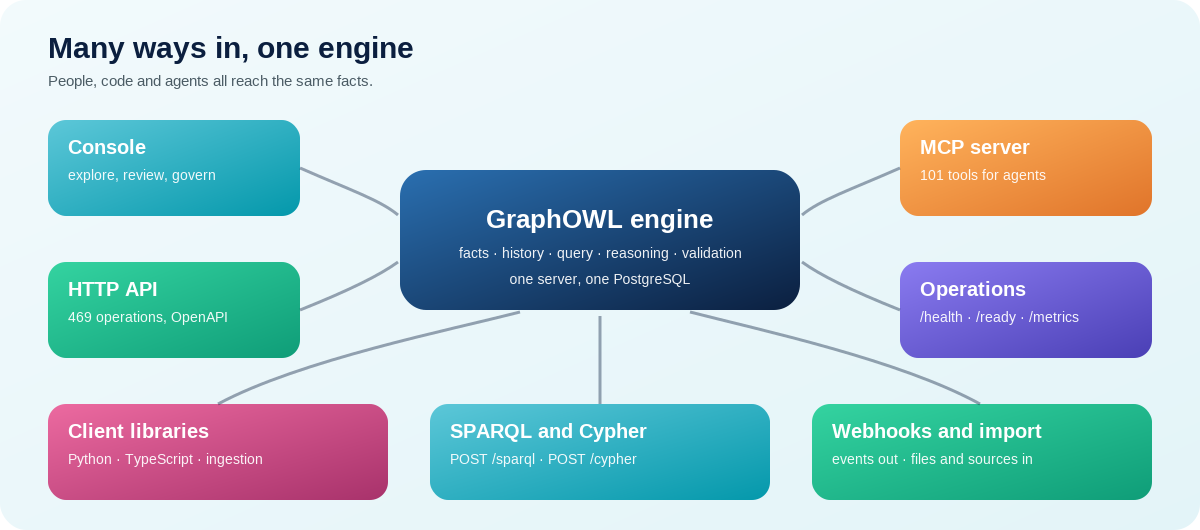
A console, an HTTP API, client libraries and an MCP server, all on the same facts.
Three properties that follow from how the engine is built, and that you can check.
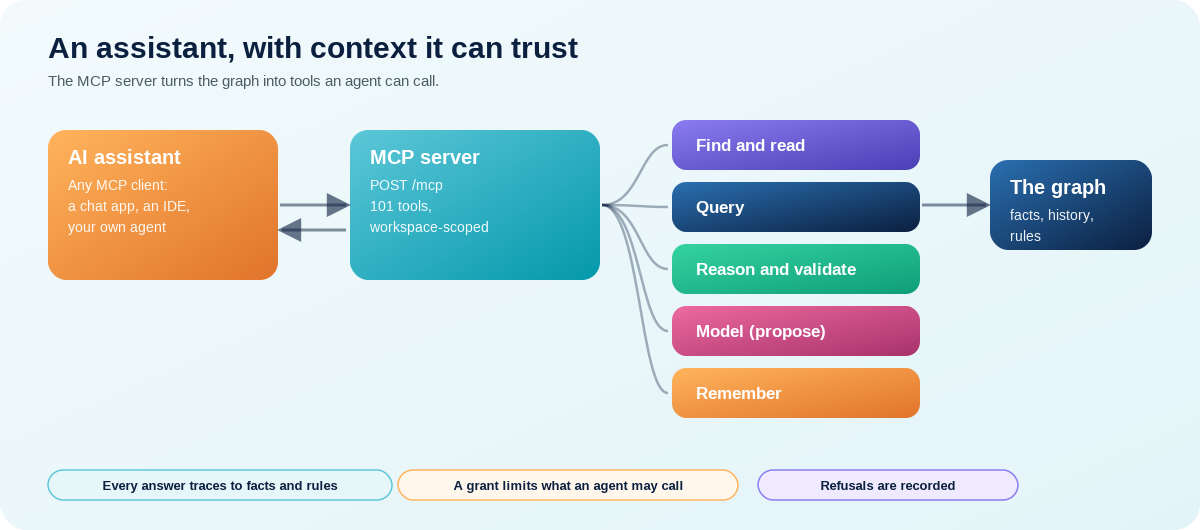
GraphOWL includes an MCP server with 102 tools. An assistant can look things up, follow relationships, run queries, propose changes and record what it learned. Every answer traces to facts and rules; agents propose and people decide.
A guided tour of GraphOWL on the dairy demo: from a database to a reviewed model, then questions, reasoning, history and agents.
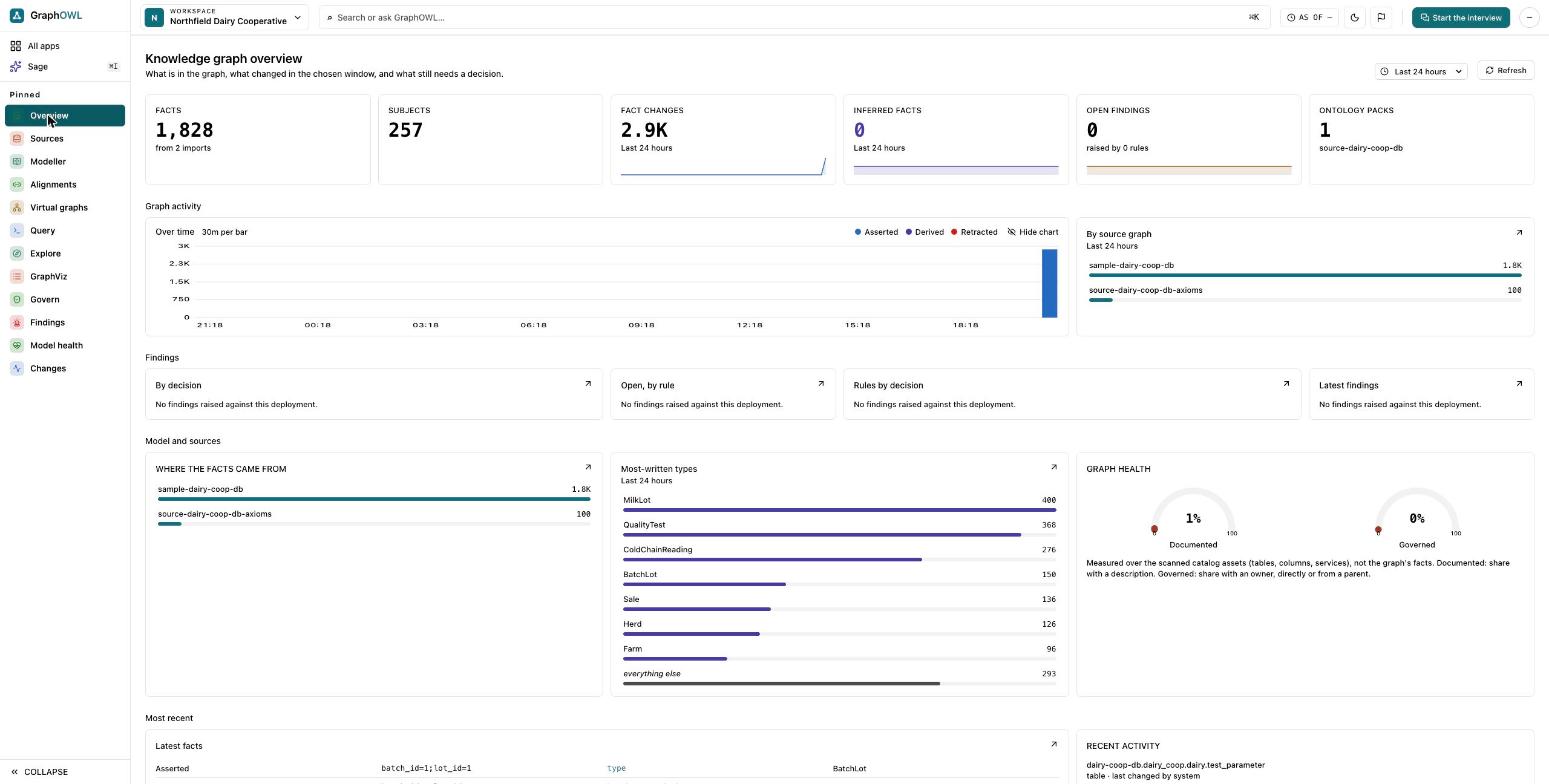
The console on a synthetic dairy cooperative: farms, milk lots, quality tests, batches and sales as one connected graph.
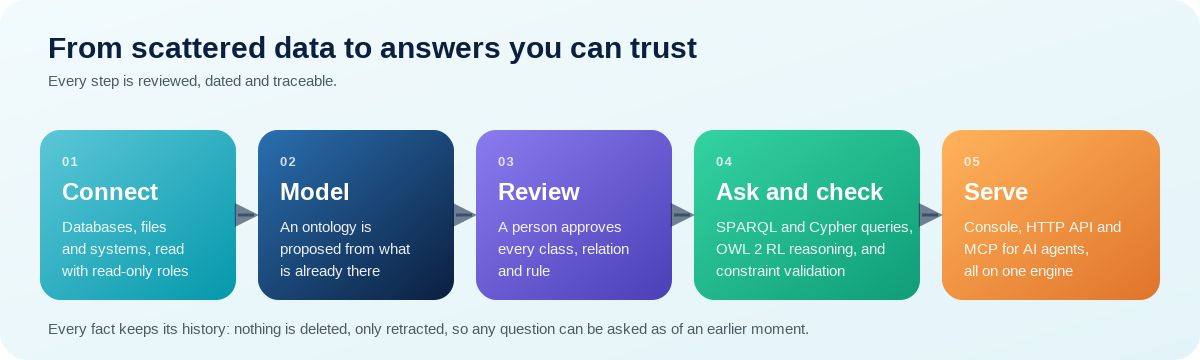
From scattered data to answers you can trust, in five steps. Every step is reviewed, dated and traceable.
Each cookbook starts from a question someone actually asks, and every query in it was run against the live demo.
A quality test failed: which lot, which batches, which retailers to call?
CatalogWhat do we have, who owns it, what depends on it?
RulesWhich records break which rule, and has anyone accepted the exception?
AgentsHow does an assistant remember what it learned, on the record?
Compared by category, on rows you can check. A general database stores rows; a graph database stores connections; GraphOWL also keeps what the connections mean.
| GraphOWL | Relational database | Property-graph server | |
|---|---|---|---|
| Meaning (ontology, rules) lives in the data | yes | no | no |
| Facts keep history; ask as of any moment | yes | rarely | rarely |
| Inferred facts are marked as inferred | yes | n/a | n/a |
| Software proposes, a person approves | yes | no | no |
| Built-in MCP server for AI agents | yes | add-on | add-on |
Categories describe typical products, not every one. If a row is wrong for a tool you use, tell us. Read the full comparison, including where the others are stronger →
GraphOWL is early access. These are the capabilities we are building toward, in no particular order. They are not all in the demo today; known limits says what is.
An ontology-aware planner that chooses where each part of a question runs, pushes work down to the databases, and keeps data transfer small.
Before a class, property or mapping changes, list the queries, constraints, virtual graphs and derived facts it affects.
From the business question, through ontology terms and approved mappings, to the generated source query and the rows that support the result.
Business questions as executable regression tests, run on every proposed change, with a quality scorecard for each pack.
Change a business fact through the model and propagate it to the right source with authorization, validation and an audit trail.
Ontology, mappings, rules and vocabulary versioned together, reviewed as semantic diffs, and reversible.
The server is written in Rust, as a workspace of small, single-purpose crates.
Memory safety without a garbage collector: whole classes of crashes and security flaws cannot be written in safe code, and there are no collector pauses to show up as latency spikes.
The server, the API and the console ship as one program. No runtime or virtual machine to install, and few moving parts to operate.
A fact has a source, a derived fact is marked derived, a model change needs review. These are encoded in types, so breaking them is a compile error.
No benchmark figures are claimed yet; they will be published with the method that produced them.
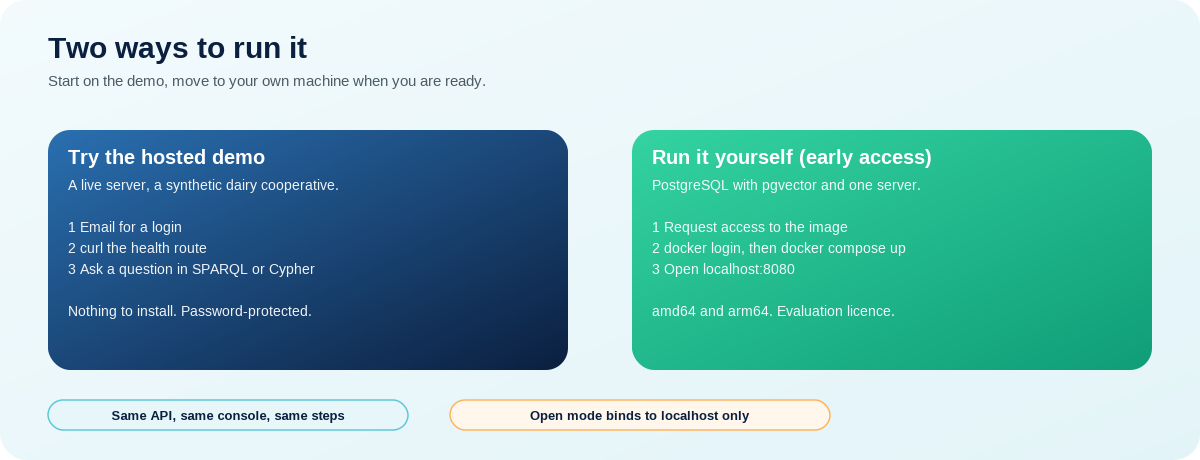
A live server loaded with a synthetic dairy cooperative. Get 30 minutes of hands-on access at once, or book a walkthrough call with the author.
Book a timeAn early-access container: PostgreSQL with pgvector and one server, started with docker compose, on amd64 or arm64. Provided under an evaluation licence.
GraphOWL is in early access: the API may change before 1.0, and known limits are listed plainly.
Five minutes to a first question, on the demo or on your own machine.